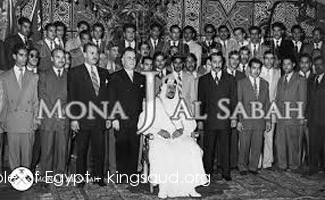
During the reign of King Saud—may God have mercy on him—he was keen to fulfill his father’s will regarding Egypt. When he learned that disagreements had arisen between President Muhammad Naguib and Deputy Prime Minister and Minister of Interior Gamal Abdel Nasser, he hastened to Egypt, seeking to bring their views closer and exerting every effort to resolve the dispute between them.
After Egypt announced its decision to nationalize the Suez Canal on the international stage, King Saud immediately sent an urgent telegram to the Saudi ambassador in Cairo, stating:
“Meet the President at once and convey to him, in our name, our full support for the step he has taken in nationalizing the Company. We are confident that the President knows our position, our orientation, and our absolute support for him in all fields of cooperation. Convey to His Excellency our greetings and best wishes.”
King Saud’s supportive stance toward the nationalization was not a personal position alone. Crown Prince Faisal—may God have mercy on him—also expressed his support for Egypt during an interview with a correspondent from Egyptian Radio, saying:
“This is Egypt’s right, and I do not believe that the various states will resort to force to impose their views. I see that the matter has concluded in a way that serves the interests of your country.”
When Britain, France, and Israel launched the Tripartite Aggression against Egypt, King Saud ordered a general mobilization and preparations to defend the Arab nations and fulfill the duty dictated by Arab solidarity. He considered his country a direct party in confronting Israel, Britain, and France. He joined hands with President Gamal Abdel Nasser and placed all of the Kingdom’s economic, geographic, and military capabilities at the service of managing the conflict against the aggressors.
The matter did not stop there. King Saud ordered the Ministry of Defense to open volunteer enlistment offices across the Kingdom for those wishing to join the Arab armies. Crowds flocked to these offices seeking the honor of military service. At the forefront of the volunteers were several princes:
- Abdullah Al‑Faisal, former Minister of Interior
- Fahd bin Abdulaziz, Minister of Education
- Abdullah bin Abdulaziz
- Sultan bin Abdulaziz
- Mishal bin Abdulaziz
- Mishari bin Abdulaziz
- Nawwaf bin Abdulaziz
- Nayef bin Abdulaziz
And other princes who donned military uniforms, carried weapons, and participated in military exercises. Saudi students studying in Egypt also recognized their duty; they joined training programs and took part in Egypt’s defense. Photographs of the princes in military uniform in Egypt were published in an Egyptian newspaper, and copies of these images are preserved in the Khoja Museum in Jeddah.
The government also issued an order prohibiting the loading and refueling of British and French ships, as well as other vessels carrying cargo destined for those two countries. It also cut the pipeline extending to Bahrain, from which these states benefited—unconcerned with the financial losses this might cause to the Saudi treasury.
Meanwhile, the Kingdom placed its oil resources at Egypt’s disposal. Ninety‑five thousand tons of oil were shipped to Egypt aboard tankers flying the Saudi flag, declaring to the world that Saudi Arabian oil is for the Arabs and for their defense, first and foremost.
King Saud’s fraternal stance in supporting Egypt during the Suez Crisis of 1376 AH / 1956 CE was honorable and courageous. President Gamal Abdel Nasser praised this position greatly in a speech delivered after Friday prayers from the pulpit of Al‑Azhar Mosque on 9 November 1956.
The Kingdom also provided Egypt with 100 million dollars on 27 August 1956, after the United States withdrew its offer to help build the High Dam.
In the early 1960s, relations between the two countries deteriorated due to the events in Yemen. Egyptian media, particularly the “Voice of the Arabs” radio station under Ahmed Said, launched a fierce campaign against the Saudi leadership.
It is reported that King Faisal—may God have mercy on him—would listen to “Voice of the Arabs” as it insulted the Saudi leadership. One of his daughters began cursing Abdel Nasser, but he forbade her, saying:
“Our Prophet, peace be upon him, was neither insulting nor foul‑mouthed. Pray instead that God guides him, for he leads a great people.”
After the 1967 defeat, many expected King Faisal to gloat over Abdel Nasser and Egypt. Instead, King Faisal—may God have mercy on him—called upon Arab leaders to stand by the sister states that had been attacked (the frontline states), to provide political support, and to allocate substantial funds to enable them to endure. Saudi support for Egypt continued until the October 1973 War, during which the Kingdom contributed significantly to Egypt’s pre‑war expenses and led the oil‑power strategy in support of the war effort.
During the reign of King Khalid, despite the Kingdom’s disapproval of President Sadat’s visit to Israel and the Camp David Accords, relations between the two countries and their peoples remained strong.
As for King Fahd bin Abdulaziz, he famously said that Egypt is “full of the heart and the eye,” a phrase that speaks for itself regarding the depth of the relationship.
Under King Abdullah—may God preserve him—the harmony and understanding between the Saudi and Egyptian leaderships continued across many political and economic issues.
During Egypt’s youth revolution, King Abdullah affirmed the Saudi leadership’s support for Egypt—its government and its people. Although King Abdullah’s position was clear, sincere, and loyal to Egypt and its people—calling for stability and the preservation of Egypt’s internal security until the end of President Hosni Mubarak’s term—some misinterpreted his words, driven by those seeking discord between the two nations and their peoples, though they would never succeed.
The King’s stance stemmed from his political experience and foresight regarding the turmoil—both visible and hidden—that Egypt would face during the crisis, fueled by the enemies of the nation openly and secretly. He foresaw conflicts among military factions, legal and judicial figures, and political parties, with the unfortunate victim being beloved Egypt and its dear people.
Time will prove the wisdom of King Abdullah—may God return him safely and in good health to our homeland, God willing.
May God protect the Land of the Two Holy Mosques, the Land of the Nile, and all Muslim countries from every harm and misfortune.
Majid Al‑Mutlaq
President of the Literary Club
Arar Newspaper